
How to Calm Your Nervous System When You're Stuck in Survival Mode: 3 Somatic Techniques That Work Right Now
By Chloë Bean, LMFT · Licensed Marriage & Family Therapist on Anxiety, burnout, perfectionism, trauma, and nervous system patterns underneath chronic overthinking. Last updated: July 2026
If your body feels stuck and uptight all the time — your shoulders are up, jaw is tight, and your mind is already three steps ahead of you. So, the fastest way to calm your nervous system is to give it a physical sign of safety, not a coaching session. Three somatic techniques that work well with my clients include: lengthening your exhale (resonance breathing), letting your eyes find something neutral in the room (orienting), and thinking of a peaceful place or protective symbol (resourcing). None of these are a cure for chronic stress but they're tools for stepping out of bracing long enough to find more clarity, which is the whole point, because a nervous system stuck in survival mode can't problem-solve, create, or rejuvenate.
Before we get to the how, one thing worth saying plainly: if you're living in survival mode, your body isn't malfunctioning. It's responding exactly how it was designed to while under large amounts of overstimulation and pressure that would tax anyone. The goal here isn't to override that response, but to work with it.
Prefer to practice these in real time? I walk through all three techniques in the video below or keep reading for step-by-step guidance.
KEY TAKEAWAYS
Survival mode is a sustained fight-or-flight state where your nervous system is reading ordinary demands as ongoing threats.
You can't think your way out of this, because the logical part of your brain goes offline first when under stress.
Somatic techniques for anxiety work from the bottom-up: they send safety cues to the body, which the brain registers more quickly than any reassurance alone.
Resonance breathing (a longer exhale than inhale) shifts you toward rest by engaging the parasympathetic system.
Orienting (letting your eyes land on something neutral) tells your brainstem the environment is safe in the present moment.
Resourcing (holding a protected, settled image) gives your system a felt reference for calm when your own calm feels too far away.
Table of Contents
What "survival mode" actually is
Survival mode is what happens when your fight-or-flight response stops being an occasional alarm and becomes your baseline. Your sympathetic nervous system (the branch built for emergencies) stays switched “on”, flooding you with alertness and tension from adrenaline and cortisol spikes meant for short bursts of self preservation, except now there's no lion and no clear end. The threat is a calendar, yet another notification, a relationship, a financial deadline, on top of a body that doesn't feel safe to slow down.
Nervous system regulation is simply your body's ability to move between survival states, of course you ramp up when something genuinely needs your energy, and natural deactivation is when your system can come back down when that event has completed. But, in survival mode, that second half doesn’t get to complete. You can escalate, and then you stay escalated…so you can't fully return to rest. This is why it’s so hard to “just relax” even when you desperately want to.
Signs you're stuck in chronic bracing
Chronic survival mode rarely feels like a crisis because for many high-functioning people, it hides behind a “put together” mask. You might recognize it as:
A body that's tense before anything has even happened, you might wake up with shallow breathing, tightness in the chest, and a feeling of doom before you get out of bed.
Trouble falling asleep, or waking at 3 a.m. with your mind overthinking, worrying, or ruminating.
Feeling wired and exhausted at the same time (I call this having your break and gas pedals pressed at once).
Snapping at small things, or going numb and shutting down when you'd normally have an emotional response.
A sense that you can't slow down: that if you stop, everything will fall apart.
Getting through the day on adrenaline and crashing the moment there's nothing left.
Concentration that is all over the place, decisions that feel impossible, creative work feels hard to connect with. (For more on this specific pattern, check out my blog about Why High-Achieving Women Struggle With Decision Paralysis.
If several of these are familiar, you aren’t weak. You’ve been holding a load for a long time without a real chance to discharge it. Untreated, this can lead to high-functioning burnout— which hides behind competence until your reserves are gone.
Why your nervous system gets stuck here
Your body doesn't measure stress one event at a time. It measures the total load — and right now, for a lot of people, that load is over-stacked. You have work that never ends, caregiving responsibilities, pressure to look put together for others, and constant news updates. You might have old trauma that primed your system to scan for uncertainty, reading it as danger before anything has actually happened.
As I explained in Straight Arrow News, rising anxiety often reflects ongoing nervous system dysregulation in a culture of constant stress and overstimulation — the body staying activated in a world that rarely signals it's safe to stand down.
When multiple stressors collide, each one lowers your threshold and you move deeper into a survival state (fight flight or freeze). So a person carrying several stressors at once isn't overreacting to "small" things; they're reacting from a system that's already near the edge of collapse. This is the piece most advice skips, and it's why "just chill” lands as almost insulting. Your nervous system is doing exactly what a well-functioning threat-detection system does under sustained pressure. The problem isn't you. It's all the pressures with not enough support to lift away long enough for your body to reset.
(I write more about this collective, shared survival mode — why so many of us can't seem to slow down — in a companion essay on my Healing In Tune Substack.)
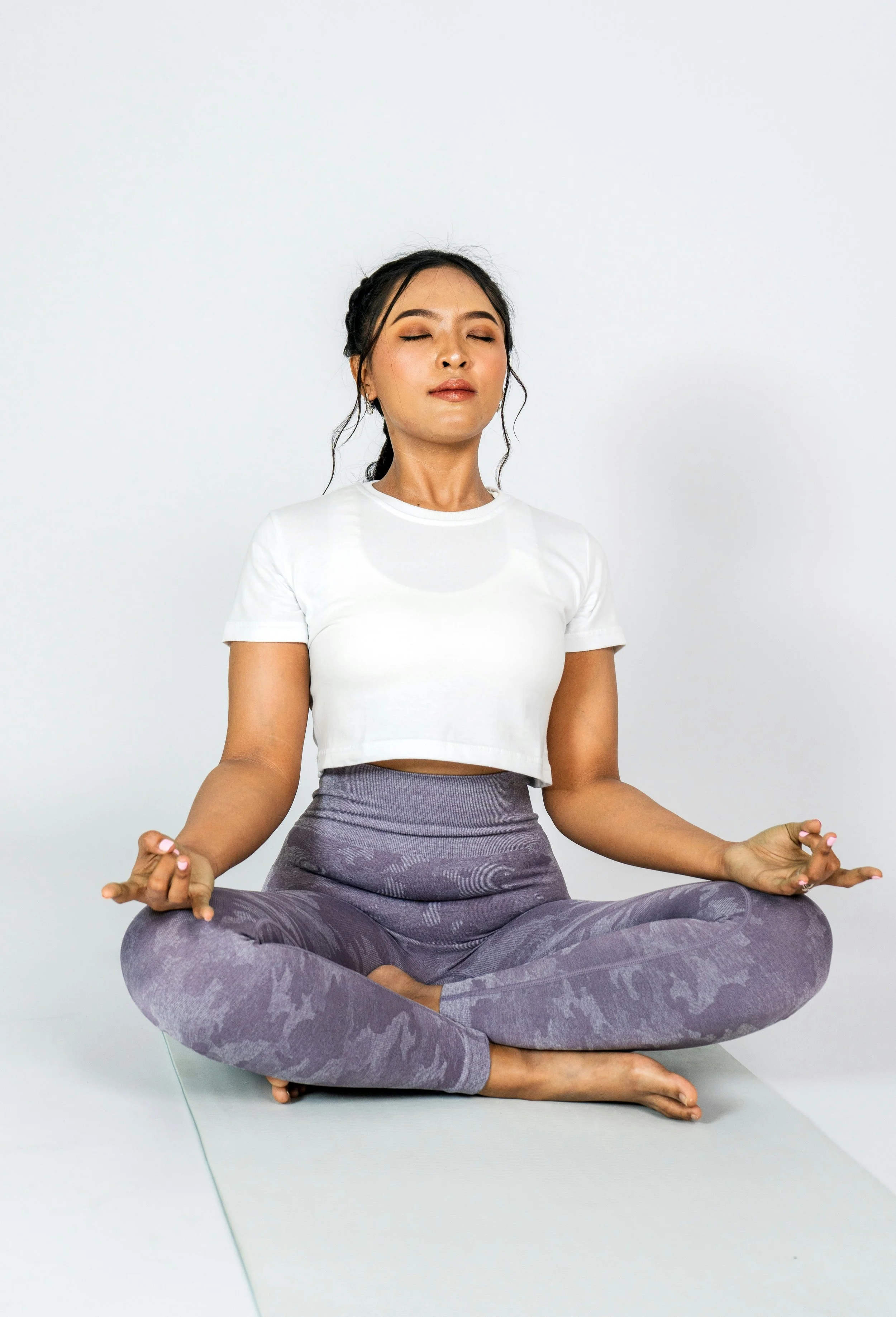
High-achieving woman using resonance breathing for survival mode and anxiety — somatic trauma therapy Los Angeles
Why pushing through makes it worse
Here's the part that matters most strategically, especially if you're the kind of person who solves problems by working harder: you cannot out-run your nervous system.
When you're in fight-or-flight, blood and energy are sent to the parts of you built for immediate survival and away from the prefrontal cortex — the region responsible for planning, perspective, nuanced judgment, and creative thinking. In a review in Nature Reviews Neuroscience, neuroscientist Amy Arnsten showed that even mild uncontrollable stress triggers a flood of stress chemicals that rapidly weakens the prefrontal cortex while strengthening the more primitive, reactive circuits of the amygdala — effectively switching the brain from thoughtful regulation to reflexive survival mode. So, when you’re under threat, your thinking brain literally gets less of what it needs to function well in order for you to have the highest chances for surviving. So the more braced you are, the worse you get at the exact things you're working so hard to handle: thinking clearly, making decisions, solving the problem, doing good work. You get caught in a bracing-now more-bracing cycle.
Fighting your body and pushing through keeps you “on” even more so you’re not actually getting what you need. The alarm keeps your creative juices low while you burn through your reserves trying to force a system to keep producing. Over time, that's the road to burnout and functional freeze — not because you're not capable, but because no one can run emergency physiology indefinitely and stay present.
Which is why the move isn't more effort. It's giving your body a reason to stand down, even briefly, so your full capacity comes back online. That's what these three techniques do.
Technique 1: Resonance breathing (lengthen the exhale)
What it is. Resonance breathing means slowing down your breath, roughly five to six breaths per minute — with your exhale longer than your inhale. You don't need to count perfectly, just make sure the out-breath longer than the in-breath.
Why it works on the nervous system. Your breath is one of the few automatic functions you can also control on purpose, which makes it a direct line into your autonomic state. Inhaling gently activates the sympathetic (alerting) branch while exhaling activates the parasympathetic (calming) branch through the vagus nerve. Your heart rate actually speeds up a little on the in-breath and slows on the out-breath. So when you deliberately lengthen and soften the exhale, you're tilting the whole system toward rest and feeding the vagus nerve the signal it uses to apply the brakes. A systematic review of slow breathing research in Frontiers in Human Neuroscience (Zaccaro et al.) found that breathing at this slower pace reliably shifts the body toward parasympathetic dominance and is associated with reduced anxiety and increased feelings of relaxation and comfort. This also shows us the natural expansion and contraction that happens in our systems and all living organisms. Breathing at that slower resonant pace is also where your heart beat and breath can sync up efficiently, which is part of why it settles the body so well.
I shared a version of this practice with Bustle when I spoke about resonance breathing as an anti-stress tool you can do anywhere — the appeal is that it's free, portable, and works with the body's own wiring rather than against it.
How to do it.
Release your breath out fully first — most people are holding a half-filled breath without realizing it.
Breathe in gently through your nose for a count of about four. Small and smooth is better than big.
Breathe out slowly through your nose or softly through your mouth for a count of about six. Take your time with it, you’re welcome to make a little sound, like a sigh releasing.
Pause for a moment between cycles to notice the space.
Stay with it for one to three minutes. You're not trying to feel "calm" — you're just lengthening the exhale and letting the body respond in its own time.
If counting makes you tense, drop the numbers and focus on making every out-breath longer than the in-breath. That's the whole exercise.
Technique 2: Orienting
What it is. Orienting is letting your eyes slowly move around your actual environment and rest on something neutral or mildly pleasant like a plant, out the window, the texture of a wall, or the color of your water bottle. Again, there’s no effort to "relax." Just noticing what’s here and letting your gaze land where it wants to.
Why it works on the nervous system. When you're in survival mode, your attention narrows and your visual field tightens because your system is so locked in scanning for danger. Slowly orienting in your space reverses that. As your eyes take in the real room and find that nothing here is actually dangerous, you give your brainstem direct present-tense evidence of safety. This is the system that runs underneath conscious thought, and it trusts what your senses report far more than what you tell yourself verbally. Turning your head slowly when guided by your eyes also engages the muscles and nerves tied to your body's "safe and social" (ventral vagal) state, which is the opposite of the braced, forward-locked and ready posture.
How to do it.
Wherever you are, let your head and eyes move slowly — no forcing, taking your time (there’s a theme here!)
Let your gaze find the least unpleasant thing in the room. It doesn't have to be beautiful or meaningful. Neutral is plenty. If something mildly pleasant catches your eye, even better.
Rest your attention there for a few seconds. Notice its color, its edges, the light on it. Notice how your body responsds to it as you place your attention there.
Let your eyes drift to the next thing. Move slowly and stay curious.
As you go, you may notice a spontaneous breath drop on its own, or your shoulders ease a little. You don't have to make anything happen — just let what wants to happen, happen.
The slowness is the reset so if you are scanning quickly or trying to get this over with, the alarm will still be on…remember: slow, curious, and steady.
Technique 3: Resourcing with a protected image
What it is. A "resource" is anything that gives your body a felt sense of steadiness, safety, or support. Resourcing here means calling up a specific, image or memory that creates a sense of protection and/or strength and letting your body experience it’s presence. This is the tool for the moments when someone says "picture yourself safe and grounded" and your honest answer is I can't even imagine that.
Why it works on the nervous system. Your body responds to vividly imagined experience much the way it responds to a real one — picture biting a lemon and you will probably salivate as if you ate something sour. The same applies to the felt experience of safety. Holding a clear image of a symbol/being, or experience you had can give your system a template of regulation to attune to. And if picturing yourself in that state is not yet accessible, which is common after a long stretch in survival mode — an external image carries no pressure and no self-judgment, so the body can settle toward it instead of bracing against it.
How to do it.
Choose an image of something cared for, safe, or strong. A favorite: a strong tree that's tended and rooted, weathering wind without being uprooted — or an animal that is well-loved, fed, warm, and protected. Something whose safety isn't in question.
Make it specific. What does the bark look like on the tree and how does the light move through the branches? Where is the animal resting; what does its slow breathing look like? Detail is what makes it land in the body.
Notice if there's any small shift as you hold the image, what do you start to experience in the body? Maybe a slower breath, the jaw releasing, or a little more weight settling into your seat. Stay with whatever you find, even if it's subtle.
If it feels available, gently let yourself be near the image: sitting under the tree, or next to the resting animal. If even that's too much, just keep watching it from a comfortable distance. Borrowing the calm is enough; you don't have to inhabit it.
This is a practice, not perfection. So if your own grounded self feels unreachable today, the protected image holds it for you until it doesn’t need to anymore.
The three tools at a glance
| Tool | What it does | Best for | Time |
|---|---|---|---|
| Resonance breathing | Engages the parasympathetic brake via a longer exhale | When you're wired, racing, or holding your breath without realizing it | 1–3 min |
| Orienting | Gives the brainstem present-tense evidence of safety | When your mind is stuck in worst-case scanning or you feel trapped at your desk | 1–2 min |
| Resourcing | Offers a felt template of calm to borrow | When picturing your own calm feels impossible or too far away | 2–5 min |
A note on what these are and aren't: each one offers genuine, temporary relief from chronic stress. That relief is real and worth having because it's how you reconnect with yourself throughout your day. But repeatedly dropping out of survival mode for good can require deeper, more sustained work. It means addressing what's keeping the alarm on in the first place: the inner critic, possible trauma history, and the patterns that taught your body the world isn't safe. Tools manage your state, but compassionately working at the root is what changes your baseline. This is also why quick 15-minute resets help in the moment but rarely resolve burnout on their own.
How Somatic Therapy Helps With Survival Mode
In her practice, Chloë Bean, LMFT integrates Somatic Experiencing, EMDR therapy, and Internal Family Systems (IFS) to support high-achieving women working through anxiety, burnout, perfectionism, people-pleasing, functional freeze, chronic overthinking, and self-trust issues.
What working together looks like
Sessions with Chloë Bean, LMFT are 50 minutes and available virtually throughout California, with in-person availability in West Los Angeles on Tuesdays.
Work together tends to include:
Understanding your nervous system patterns around decisions and uncertainty
Working with the parts of you that are trying to protect you from regret or shame (IFS)
Processing past experiences where mistakes felt emotionally unsafe (EMDR)
Building somatic awareness of how anxiety and perfectionism live in your body — the same body-based signals I described in Why Anxiety Shows Up in the Body.
Developing genuine self-trust — not the absence of doubt, but the capacity to do the hard thing anyway
FAQ: Somatic Therapy for Survival Mode
How do I calm my nervous system fast? The quickest reliable method is to lengthen your exhale — breathe out slowly for longer than you breathe in, for a minute or two. A long, soft out-breath activates the parasympathetic ("rest") branch of your nervous system through the vagus nerve, which is your body's built-in brake. Pairing it with slow orienting (letting your eyes rest on something neutral in the room) tends to work even faster.
What is survival mode? Survival mode is a sustained fight-or-flight state where your nervous system treats ordinary, ongoing demands as continuous threat. Instead of switching the stress response on and off as needed, your body keeps it running, which leaves you tense, wired-and-tired, and unable to fully rest even when nothing is actively wrong.
Does resonance breathing actually work, or is it just a distraction? It's not a distraction — it's a physiological lever. Slowing your breath to about five or six breaths a minute with a longer exhale measurably shifts your autonomic balance toward rest, because the exhale is the part of the breath cycle tied to your body's calming system. You're not ignoring the stress; you're directly changing the state your body is in.
Are these techniques a cure for chronic stress or anxiety? No, and it's worth being honest about that. These are tools for temporary relief — they help you step out of bracing in the moment so you can think and function. Lasting change usually means addressing what keeps the alarm switched on: chronic load, past trauma, and the patterns underneath. The tools and the deeper work go together.
Why can't I just think my way out of feeling anxious? Because under stress, the reasoning part of your brain gets less resourced while the alarm system takes priority. That's why reassurance and logic so rarely land when you're activated. Somatic techniques work bottom-up — they send a safety signal through the body first, which is the language your nervous system actually responds to, and then clearer thinking becomes available again.
Can I do this on my own, or do I need a therapist? You can absolutely use these on your own — they're safe, and most people feel something within a few minutes of practice. If your survival-mode state is rooted in trauma or has been running for years, working with a somatic or trauma-informed therapist can help you change the baseline, not just the difficult moment. The self-tools and the professional support do different jobs.
Final Reflection
If your nervous system has been stuck in survival mode for a long time, these tools can give you real relief in the moment — and you deserve more than momentary relief. Changing the baseline, so rest stops feeling dangerous and calm starts to feel like yours, is the work I do with clients every day.
As I shared in HuffPost, for someone used to running hot, stillness can register as unfamiliar and even unsafe — which is exactly why slowing down can stir up anxiety at first, and why building tolerance a few minutes at a time is the way through rather than forcing it.
If you're in California and this sounds like what you've been carrying, you're welcome to request an intake session — my practice is currently full, so I'll add you to the waitlist and reach out as space opens. If you'd rather not wait, a somatic or EMDR intensive is a way to do focused, in-depth work on a faster timeline. Either way, your body has been asking for this for a while. It's allowed to have it.
→ Request an Free Consultation
→ Explore Therapy Intensives
Work with Me
Related Reading & Resources
Functional Freeze: When Everything Looks Fine But Your Nervous System Is Not
High-Functioning Burnout in Women: The Hidden Cost of People-Pleasing and Living in Survival Mode
Why Anxiety Shows Up in the Body: 7 Somatic Signs of Stress You Shouldn't Ignore
Why Burnout Makes Everyday Tasks Feel So Hard (It's Not Laziness)
The Somatic Cost of People-Pleasing: How Chronic "Niceness" Impacts Your Body and Relationships
Somatic Trauma Therapy vs Talk Therapy: Why High-Functioning Adults Often Need a Body-Based Approach
Sources
Zaccaro, A., et al. (2018). How Breath-Control Can Change Your Life: A Systematic Review on Psycho-Physiological Correlates of Slow Breathing. Frontiers in Human Neuroscience. https://www.frontiersin.org/journals/human-neuroscience/articles/10.3389/fnhum.2018.00353/full
Arnsten, A. F. T. (2009). Stress signalling pathways that impair prefrontal cortex structure and function. Nature Reviews Neuroscience. https://pmc.ncbi.nlm.nih.gov/articles/PMC2907136/
About the Author
Chloë Bean, LMFT is a licensed marriage and family therapist and somatic trauma therapist in Los Angeles. She works with high-achieving women on anxiety, burnout, perfectionism, people-pleasing, toxic relationship recovery, and the nervous system patterns underneath chronic overthinking. Her approach integrates Somatic Experiencing, EMDR, and Internal Family Systems (IFS) — body-based work that reaches what talk alone can miss. She sees clients virtually throughout California and in person in West Los Angeles, and her practice is currently full with a waitlist. Her insight has been featured in Real Simple, Greater Good Magazine, Forbes, SELF, HuffPost, and Bustle.
→ Learn more about working together
Find Chloë Bean, LMFT on LinkedIn, Instagram, YouTube, and Psychology Today.